SECOND
TASK FORCE
Armored
thrusts had raced miles east of the limit of the Division’s advance leaving it
in the rear areas.
On
April 3rd Company A, with the 2nd Reconnaissance Platoon attached, was attached
to the 6th Cavalry Group and joined them at Huhlbach 55 miles to the northeast,
ten miles northwest of Hersfeld.
Company
C, with the 1st Reconnaissance Platoon attached, was attached to the 345th
Infantry Regiment and Company B, with a 3rd Reconnaissance Platoon attached,
was attached to the 346th Infantry Regiment.
On
April 4th the Battalion CP, plus Reconnaissance Company minus three platoons,
moved to Ronshausen, 70 miles to the northeast with Companies B and C moving
into assembly areas in that vicinity with the infantry regiments.
On
April 6th Company A was relieved of attachment to the 6th Cavalry Group and
joined the Battalion, assembling at Bebra, three miles northwest of Ronshausen.
On
the following day the 87th Division went into action. Company A supporting the 347th Infantry Regiment moved southeast
40 miles to Ober-Schonau, ten miles southwest of Ohrdruf, and placed guns in
position near there. Company B moved to
the vicinity of Bairoda, fifteen miles northwest of Ober-Schonau. Company C advanced to the vicinity of
Tambach, five miles north of Ober-Schonau, where they fired on enemy troops and
destroyed one MK IV tank. The Battalion
CP moved to Floh, six miles northwest of Ober-Schonau. During the next two days the regiments
slowly advanced eastward fighting through heavy forests and hills, meeting some
small arms, mortar, and direct fire. By
April 9th Companies B and C had moved their CP’s to Tambach in the heart of the
Thuringen Wald. [Figure 8-1]
On
April 10th Task Force Sundt was reconstituted at Tambach. Obtaining clearance from the 89th Infantry
Division on the north, it marched through their area which was further advanced
than the 87th, passed northeast through Ohrdruf, and Arnstadt. Then the Task Force turned south back into
the 87th sector cutting behind the enemy lines. The first opposition was met at Trassdorf, six miles southeast of
Arnstadt. Here heavy direct and
artillery fire was encountered. The
Second Company moved through Ober-Willingen, one mile northeast of Transdorf,
to the high ground 1000 yards southeast where it was stopped. All efforts to advance were met by heavy
fire. The First Company was ordered to
bypass Trassdorf and drive southwest towards Ilmenau, pushing into the enemies
rear. Then the mission was changed,
orders being received to head east through Stadtilm to Rudolstadt. The First Company was ordered to the high
ground to the northwest of Stadtilm and the Second Company was ordered to move
into Stadtilm from Nieder-Wllingen. The
First moved to attack, but was stopped when heavy artillery and direct fire hit
both companies. As darkness fell, the
Task Force bivouaced in place for the night.
Company
A, in the southern part of the Division’s zone, advanced with the 347th
Infantry about ten miles, passing through the towns of Oberhof, Elgersburg,
Ober-Porlitz, Grafinau and to Cottendorf where they met determined
resistance. One Hundred SS men armed
with small arms and panzerfausts and supported by assault guns and tanks were
encountered. When a TD was hit by a
bazooka and set afire Sgt. Dominic Karr distinguished himself when he evacuated
a wounded man while under small arms and artillery fire. Disregarding his own safety, 2nd Lt. Grant
W. Claymore dashed through the mortar, artillery and machine gun fire to the
burning destroyer, climbed inside and rescued his gunner. Returning again to the destroyer which was
now aflame with burning ammunition he rescued another man. For his courageous action and extraordinary
heroism Lt. Claymore was awarded the Distinguished Service Cross. The support lent by the TD’s enabled the
infantry to take the town with very few casualties.
Company
C, with the 345th Infantry, moved through Crawinkel, Plaue, Reinsfeld and
Neiderwillingen. The 346th Infantry relieved the 345th, Company C passing to
the 346th. By evening the Task Force and the Regiments held a line generally
from just outside Stadtilm southwest to Angstadt, a distance of seven miles.
On
April 12 the 1st Company attacked Stadtilm from the north and the 2nd Company
attacked from the west. The 346th
Infantry with the 1st and 2nd Battalions abreast (not part of the Task Force)
attacked south of Stadtilm to seize and hold the high ground southeast thereof.
All bridges across the Ilm River were known to have been blown with the
exception of the main highway bridge which was not to be blown until the
Americans approached. The attack
developed with such speed that the bridge was captured intact together with the
entire company left behind to defend it. The 3rd Battalion of the 346th
Infantry followed the 2nd Company into the town and occupied it.
The
1st and 2nd Companies moved across the bridge and proceeded to the high ground
to the east and beyond, passing through Großliebringen and Kleinliebringen.
Advancing through Solsdorf, Thalendorf, Kerlau. and Eichfeld toward Rudolstadt,
the Task Force met some resistance.
Dive bombing by P-47’s was used
on enemy in Ehrenstein with good results. The 2nd Company encountered abatis on
the southwest approaches to Rudolstadt, but reduced these with the help of the
Engineer bulldozers. There they encountered heavy small arms and bazooka fire,
which destroyed one M-8 but by nightfall had taken the southwest part of the
town. The 1st Company moved to Schaala and attacked Rudolstadt from the west in
conjunction with the 2nd Company’s move to attack, but encountered a defended
roadblock and lost a tank to bazooka fire.
The 3rd Company moved up to the left of the 2nd Company in
Rudolstadt. During the afternoon the
air support strafed the high ground to the east and the enemy in the town.
Company
A, supporting the 347th Infantry, advanced south of the route taken by the Task
Force to Bad Blankenburg meeting little opposition.
Company
C, with the 346th Infantry, aided in the capture of Stadtilm and then advanced
on the left and echeloned to the rear of the Task Force. They stormed Remda,
overcoming small arms and artillery fire, and entered Eichfeld, three miles
west of Rudolstadt. The 2nd Platoon, supporting the 2nd Battalion 346th
Infantry, closed on the Task Force’s CP.
The
following day the Task Force continued their attacks on Rudolstadt in
conjunction with the 2nd Battalion 346th Infantry, trying in vain to capture an
intact bridge across the Saale River. Reaching the river after overcoming small
arms, bazooka and sniper fire, they found the bridges had all been blown, as
had all the other bridges in the division sector. The Task Force assembled 3000
yards northwest of Saalfeld prepared for immediate movement to take the high
ground in the vicinity of Possneck, twelve miles to the east
Company
A, with a 2nd Reconnaissance Platoon attached, forded the stream at Bad
Blankenburg with the 347th Infantry and advanced to take Saalfeld finding all
of the bridges across the Saale River had been blown. A bridgehead was established.
Two
platoons of Company C with two battalions of the 346th Infantry raced ten miles
eastward to the Saale and found that all the bridges had been blown north from
Rudolstadt to Uhlstadt.
At
1345 April 14th the Task Force crossed the treadway bridge erected at Saalfeld
and drove 15 miles eastward to
Peuschen, three miles southeast of Possneck, before meeting any
resistance.[Figure 8-2] The 1st Company pushed from Schmorda, two miles west of
Peuschen, was stopped by bazooka fire at the edge of the woods, losing one M-8
and crew. The 2nd and 3rd Companies,
advancing from Wernberg (one and one-half
miles south of Possneck), were stopped by intense direct fire 800 yards
west of Peuschen. The 3rd Company moved to the high ground north of Peuschen to
cover the 2nd Company’s movement into the town. The 2nd Company entered
followed by the 3rd. When darkness fell, the Task Force CP and the 1st Company
bivouacked in Wernburg.
Company
A crossed the Saale River behind the Task Force with the 347th Infantry and
advanced through Schmorda to Moxa, one and one-half miles south of Peuschen,
meeting only slight resistance, but knocking out one 75mm SP gun when Sgt.
Esposito’s crew turned in a stellar performance.
Company
C crossed the bridge at Weissen, north of Rudolstadt, at 1930 and only advanced
three miles before darkness overtook them.
The
following morning the Task Force dashed eastward meeting little resistance
through Taskau, Knau, Plothlen, Dittersdorf, Dragensdorf and Tegau, a distance of
about fifteen miles. At Tegau it turned southeast to Lawitz where heavy
artillery fire and small arms fire was encountered coming from the east and
northeast. The 3rd Company passed the 2nd moving south on the parallel road,
one mile to the west, and advanced to Kerschkau where it eliminated scattered
resistance. The 2nd Company took the lead again pushing to Lossau and southeast
to Lengenbuch, five miles east of Schleiz, where it intercepted a sizable force
of enemy moving from the town on foot and in wagons. Joined by the 1st Company all of the enemy were killed, captured
or dispersed by this force. Following this shelling the two companies moved
east two miles to Thierbach. where heavy resistance was encountered and where
they held up for the night.
Company
A with the 2nd Reconnaissance Platoon attached, advanced with a 347th Infantry
to the vicinity of Schleiz, passing generally through the Ziegenruck,
Chrispendorf and Monchgrun.
Company
C with the 1st Reconnaissance Platoon attached, moved with the 346th Infantry
Regiment to the vicinity of Possneck where they were held up at a roadblock.
Clearing it they advanced toward Zeulenroda, not meeting any resistance until
they reached Pahren, four miles west of Zeulenroda, where they encountered
direct fire. They fought their way east two miles to Klein-Wolschendorf where
they spent the night.
The
following morning the resistance continued in Thierbach with small arms
fire. The 1st and 2nd Companies
contacted the Burgermeister and requested the surrender of the town and
Garrison on threat of destruction. The request was refused. In the center of
the town was a strongly defended enemy roadblock. Disregarding his own safety
Captain J. Laverne Nicklaus reconnoitered it and then led the tanks and the
infantry into the town and directing the lead tanks fire on the obstacle and
the house filled with German troops. While directing these operations Captain
Nicklaus was killed by a sniper’s bullet. For his courageous action and
devotion to duty he was awarded the Silver Star. The 1st Company pulled back
and took positions overlooking the town. When the 2nd Company had cleared, the
1st Company destroyed the town with direct fire, taking 75 prisoners, including
a colonel.[Figure 8-3]
The
3rd Company bypassed the town and proceeded across country, bypassing the city
of Pauss, going to Unterpirk, Bernsgrun, Frabersgrun, to Steindorf and then
racing to the Weisse-Elster River hoping to capture a bridge at Barth
Mahlen.[Figure 8-4, Figure 8-5] The 3rd Company closed on the tail of a German
artillery battery in the process of crossing the bridge. In the fight that
ensued the road was blocked with knocked out artillery, horses and Germans. The
delay was sufficient to permit the Germans to blow the bridge. Reconnaissance to
the north located the railroad bridge at Cossengrun still intact. Seizing the
bridge 1st Lt. Morrow moved his company across and on to Jocketta, Helmsgrun
and Gansgrun, where they met intense tank fire. One Sherman tank was destroyed.
The Company later moved to Altensalz.. The 2nd Company proceeded to Neuensalz.,
three miles east of Plauen, fording the river at Barthmahlen The 1st Company
moved through the 2nd Company and on to Mechelsgrun. The Task Force CP moved across the railroad bridge, then south to
Neuensalz, taken shortly before by the 2nd Company after a sharp fight.
The
1st Platoon of Company A, with the 3rd Battalion 347th Infantry, advanced from
Schleiz through Langenbuch, Muhlstroff, Mehltheurer, Syrau to Plauen where they
seized and secured a bridge. S/Sgt. John T. Johnson, Company A, was given the
mission of seizing this bridge across the Weisse-Elster River. He mounted a
squad of infantry on two destroyers and led his small task force from the edge
of the city through two miles of devastated blocks and almost impassable
streets. The smoking tracks of a German tank were a risky but welcome aid in
finding the way. Moving rapidly toward his objective he surprised the enemy,
seized the bridge and engaged in a firefight with the Jerry’s who were firmly
established in three buildings over watching the bridge. Covered by the fire of
his comrades, S/Sgt.Johnson fearlessly entered the buildings alone and captured
one SS officer and ten enlisted men.
His award was a Silver Star for gallantry. Also in this vicinity Lt. Daniel M. Auvil of Company A was making
a motorized reconnaissance in advance of a task force when he encountered an
enemy patrol consisting of a reconnaissance car and two motorcycles. Lt. Auvil opened fire with his machine gun
mounted on the jeep eliminating the reconnaissance car and one motorcycle. When
his ammunition became exhausted, Lt. Auvil returned to the Task Force, led a
light tank forward and directed it in destroying the remaining motorcycle,
preventing the enemy from obtaining knowledge of the Task Force. For his heroic action and initiative Lt.
Auvil was awarded the Silver Star. The
3rd Platoon of Company A with the 1st Battalion 347th Infantry drove from
Langenbuch south through Plauen to Oelsnitz, meeting no resistance, but firing
upon fleeing Germans.
Company
C with the 346th Infantry headed east with the mission of seizing a bridge over
the Weisse-Elster River at Elsterberg.
On entering the town they met small arms, machine gun and one round of
88mm fire. Sgt. Benner caught the 88mm
flash; Cpl. Green destroyed the gun with his first round.[Figure 8-6] The
bridge was seized and the high ground east of town secured.
On
April 17th the 3rd Company of the Task Force pushed east and seized Bergen. The
1st and 2nd Companies move to a Unter-Lauterbach and Trieb, both northeast of
Bergen.
The
1st Platoon of Company A advanced with the 3rd Battalion of the 347th Infantry
to Theuma, four miles southeast of Plauen.
The
1st Platoon of Company C with the 1st Battalion 346th Infantry advanced six
miles southeast to Treuen, taking it without opposition. The 2nd Platoon with the 2nd Battalion 346th
Infantry pushed on to Leugenfeld, four miles northeast of Treuen, where four
light tanks were destroyed by a 75mm Jerry tank destroyer. The panzerjaeger was destroyed by
Sgt.Chriske’s gun, Cpl. J. T. Wilson gunner, and the Battalion took up a
defensive position around the town.
On
April 18th and 19th Task Force Sundt remained in place patrolling to the
east. Enemy patrols entered each of the
company's areas, destroying one M-20 but sharpshooting by Sgt. Stella accounted
for the German leader. On April 20th the Task Force, less the Infantry Company,
assembled in the vicinity of Neuensalz.[Figure 8-7]
The
dash made by this 2nd Task Force Sundt netted 109 miles and 1344 prisoners in
nine days. Once the break was made through the Jerry’s lines, the scene became
a mad rush, fighting through or bypassing defenses – speed was the
watchword. To stop was to be pinned
down; to continue was to crush Jerry’s frugal attempts to delay and leave a
string of dead Jerries and burning German vehicles behind. The Germans had
pitted the 11th Panzer Division, the so called “Ghost Division” in the 87th
Division zone to “stem the tide”, but to no avail.[Figure 8-8] The speed with which the Task Force operated
was too great to permit a defensive position to be properly set up. 2 tanks, 11
trucks, 4 half-tracks, 3 armored cars, 6 wagons, 3 tractors, 3 motorcycles,
3-75mm guns, and 1-105mm gun were destroyed in comparison with our losses of 1
tank, 2-M8’s, 1-M20, and 1 half-track.
During
the two week period April 23-May 6,
elements of the Battalion remained in defensive positions, conducting
maintenance of equipment. Very few changes of locations were made. On May 6th
Task Force Sundt was dissolved; its mission completed. The battalion elements remained in assembly
positions near Neuensalz.
The
most terrible war of all time was drawing to a close. Junctions between the
Americans and Russians were imminent all along the front. To prevent
unnecessary casualties limiting lines were established beyond which no one
could advance. For the 87th Division it was the Mulde River. On May 6th the
347th and the 346th Infantry Regiments, with Companies A and C in support,
advanced about twelve miles east against slight resistance. On this drive Sgt. Charles P. Patnude,
Company C, encountered a very effective roadblock at the railway underpass in
the vicinity of Falkenstein. Two box cars had been removed from the railroad,
placed across the road and covered by artillery, mortar and machine gun
cross-fire. Sgt. Patnude, taking his
destroyer into the underpass, pushed the boxcars apart so he could fire at the
hostile machine guns. After knocking out the machine guns Sgt. Patnude and two
crew members, while still under heavy mortar and artillery fire, dismounted and
hooked a cable from the destroyer to the railroad cars and pulled them to the
side of the road, enabling friendly troops to advance. For his courage and leadership
he was awarded the Silver Star. After
reaching their objectives, patrols were sent to the Mulde River taking hundreds
of prisoners. On May 7th the Battalion
CP, Reconnaissance Company and Company B moved to Fredrucksgrun, four miles
southeast of Falkenstein. On the 8th
and 9th Companies A and C assembled with the Battalion at Fredrucksgrun. Peace had been signed.[Figure 8-9] A brilliant record was closed. The greatest of all wars was finished and
the lights went on again all over Europe.
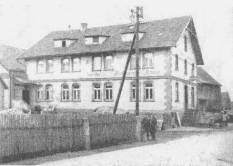
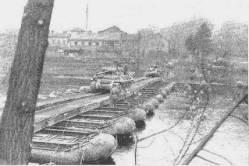
Figure 8-1 Figure 8-2
Typical C.P. in Germany 607th Crossing the Saale at Saalfield
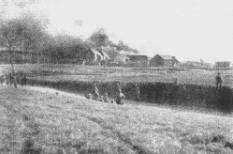
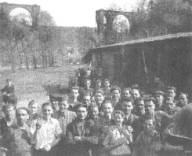
Figure 8-3 Figure 8-4
Thierbach Burns- Liberated D.P.’s near Barth Mahlen
A Monument to Captain Nicklas
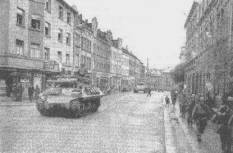
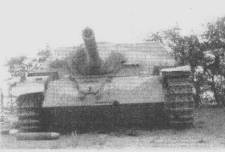
Figure 8-5 Figure 8-6
Passing through the Streets of Last Armored Vehicle Destroyed by 607.
Rodewisch on the Way to Company C Destroys a German T.D.
German Held Auerbach
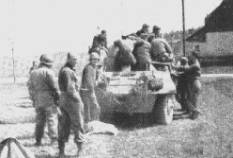
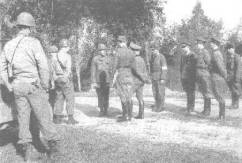
Figure 8-7 Figure 8-8
Radio Contact with the Russians The
War’s End.
from Neuensalz A German Division Surrenders
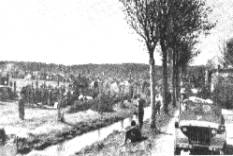
Figure 8-9
Mass Surrender after
Peace Was Signed