RHINE BATTLES
THE
APPROACH
The
Division advanced slowly eastward along a six mile front extending from
Kronenburgerhutte to Neuendorf being held up frequently by mines, blown bridges
and artillery. On March 6th the 3rd
Platoon Company C and the pioneer platoon was attached to Task Force Muir,
which had the mission of capturing a bridge across the Kyll River near
Lissendorf, 10 miles away. They
advanced rapidly against some artillery and mortar fire and by noon had reached
Lissendorf, only to have the bridge blown up in their faces. The third Platoon fired at enemy across the
river while the Pioneer Platoon built a foot bridge over which the infantry
crossed. The stream was shallow enough
to be forded by vehicles. The remainder
of Company C marched in column to the Kyll.
Company
A, moving behind the Task Force, and supporting the 347th Infantry, established
its CP at Lissendorf. By March 7th the
Battalion CP and Reconnaissance CP had advanced through Roth and Shonberg to
Lissendorf. Task force Muir and the remaining elements of the 345th Infantry
crossed the Kyll river and continued to advance to the northeast through
Wiessbaum., where the pioneers were released, thence towards the Ahr
River. Company A advanced across the
river and continued as far as Ripsporf and Hungersdorf, while Company B
continued toward Stadkyll, crossed the river, and took Esch and Feusdorf. By March 9th the Division had cleared the
area to the Ahr River. Beyond this
other units had raced almost to the Rhine.
During the next five days, the Battalion remained in the same
dispositions with all companies conducting maintenance.
On
March 14th the Division was ordered to march to a position facing Koblenz. The Battalion CP, plus Reconnaissance
Company minus three platoons, moved to the Bassenheim railroad station, five
miles west of Koblenz, a distance of 80 miles.
Koblenz,
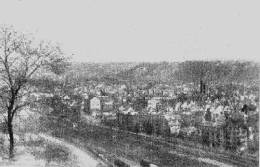
a city with a pre-war population of 90,000 people, lies in the triangle formed
by the Moselle River flowing northeast into the Rhine which flows north. The next mission of the 87th Division was to
take this historic city. All bridges
across the Moselle leading to the city had been blown isolating it from the
west.
Arriving
in this new area, Company A with the 2nd Reconnaissance Platoon attached,
stopped in the vicinity of Ochtendung, Company B, with the 3rd Reconnaissance
Platoon attached, assembled at Rubenach, and Company C, with the 1st
Reconnaissance Platoon attached, went into position near Mulheim.
On
March 16th Company A moved south to the Moselle River to Kolburn and Winningen
and supported the infantry’s crossing that night. The next two days the 347th Infantry advanced southeast towards
the Rhine, with Company A knocking out several
roadblocks and killing enemy personnel defending them. On March 17th the 2nd Platoon Reconnaissance
Company with a task force of two TD’s from Company A, two tanks and an infantry
platoon, was halted by a roadblock.
When small arms fire was received from well entrenched dominating
positions, Pfc. Novakovich, on his own initiative, moved up the hill in an
attempt to outflank the enemy.
Capturing one German he returned with a prisoner to secure prompt
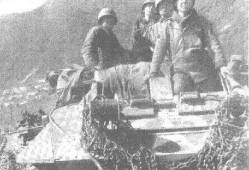
interrogation.[Figure 6-1, Figure 6-2]
He then led two comrades in a fierce and successful assault upon the
enemy positions, killing several Germans and forcing others to withdraw. For his gallantry and leadership Pfc.
Novakovich was awarded the Silver Star.
Company
B fired at German positions across the Rhine and Company C moved its CP and one
platoon to Metternick, just across from Koblenz and fired on the enemy in the
southern part of the city.
On
March 18th Company C moved across the Moselle to Lay and sent their platoons
into Koblenz with the 354th Infantry.
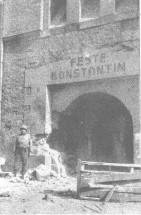
By evening they had fired at Fort Constantine.
As
the regiments moved south the Division boundary also moved south. Company B was attached to the 28th Infantry
Division and moved to Pladt in Division reserve.
Within
the next two days Koblenz was completely taken, Fort Constantine being one of
the last points to surrender.[Figure 6-3]
The third Platoon of Company C fired 29 rounds of a APC and HE and the
second Platoon fired 13 rounds APC and 27 rounds HE into the Fort. Immediately, 14 officers and 85 men
surrendered the fort to the 345th Infantry. Then the infantry moved into the city proper knocking out two
enemy machine gun nests. During this
action Sgt. Thomas C. Johnson, Company C, was awarded the Silver Star for repairing
his gun from the outside of the turret in face of vicious enemy fire, putting
it into action again in a very few minutes.
On
March 22nd, after Koblenz had fallen,
the companies assembled preparatory to moving.
Company B was relieved from attachment to the 28th Division.
THE
CROSSING
The
following day the entire Battalion assembled in the vicinity of Norterhausen,
ten miles southwest of Koblenz. The last battles for Germany were about to be
fought. Units to the north and south were crossing the Rhine and pushing deep
into Germany.
On
March 25th the 347th Infantry crossed the rhine in boats against heavy 20mm
fire, being supported by Company A firing at targets in the vicinity of
Ober-Lahnstein.
Company
C supported the 345th Infantry crossing at below Boppard. Later in the day Company C and one platoon
of Company A were ferried across at Boppard and moved to support the expansion
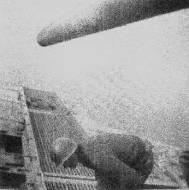
of the bridgehead.[Figure 6-4] Captain
Long, commanding officer of Company C, was given the job of getting all the
armor supporting the 345th across the Rhine. Two tanks of Company B, 735th Tank
Battalion and two TD’s of the 2nd Platoon of Company C were the first armor
working with the 87th Division to cross the Rhine. Company B later moved across
the bridge and assembled, awaiting the 346th Infantry’s crossing.