AGAINST
THE SIEGFRIED AGAIN
On
January 27th the 95th Division was relieved by the 26th Infantry Division and
was ordered to assemble in Belgium north of Bastogne. The Battalion, on the coldest day of the winter, marched 150
miles to the vicinity of Houffalize, Belgium via Boulay, Uckange, Longwy, Arlon
and Neufchateau, with the Battalion CP and Reconnaissance Company going into of
Taverneux.
During
January the Battalion destroyed 7 MK V tanks, 3 MK IV tanks and 9 pillboxes;
fired 2510 rounds in indirect fire. Two
M-36’s and one jeep were lost to enemy action,
On
February 2nd, 1945 the Battalion was relieved from attachment to the 95th
Infantry Division and attached to the 87th Infantry Division. This Division was
closing on the enemy as he withdrew from the Ardennes bulge. Passing through St. Vith, Belgium, Company
A, with the 2nd Reconnaissance Platoon attached, moved northeast 30 miles to
join the 347th Infantry Regiment in their area near the Belgian-German
border. The platoons were employed near
Berterath and Loshiem with the Company CP in Manderfeld. On February 4th,
Company C, with the 1st Reconnaissance Platoon attached, joined the 346th
Infantry Regiment and supported them in the towns of Auw, Rothand and
Wecherath. On February 5th the Battalion CP moved to Laudesfeld, Germany from
Schonberg, Belgium.
For
the third time the Battalion was facing the Siegfried Line. Complicated by mud
which made cross country movement impossible, the attack began. Roads became so
bad that stretches had to be corduroied to carry traffic.
Company
B supporting the 345th Infantry, advanced into the pillbox area [See Fig.1]
along the Schnee Eifel Ridge and took one pillbox with 50 caliber machine gun
firing. The 1st Platoon advanced until
all destroyers were stuck in the mud. Two were pulled out and continued on the
attack. On February 7th, near Roth, Lt. Calvin Stone led his platoon on foot
through heavily mined areas, keeping abreast of the advancing rifle elements.
Encountering a well fortified enemy position Lt. Stone voluntarily advanced
alone and threw a grenade into the structure.
Following the explosion he charged inside firing his carbine, killing
two and capturing six of the enemy. During the ensuing action, Lt. Stone
continuously exposed himself to enemy fire while directing his tank destroyers
in locating other enemy installations. For his devotion to duty and courage he
was awarded the Oak Leaf Cluster to the Silver Star. The same day Company B
destroyed four more pillboxes and during the next couple of days whittled their
way through pillboxes to take Olzheim and Neuendorf. [Figure 5-1] On February
11th Company C extended its front and relieved Company B which moved into
Division reserve at Wischeid (one mile west of Auw).
Due
to the terrible condition of the roads little advance was made and no relief of
the forward elements could be accomplished. Company A fired indirect, Company C
continued to support the 345th Regiment, and Company B continued maintenance of
equipment and supplied men to help construct and maintain roads. The Pioneer
Platoon worked on roads and prepared alternate positions for destroyers. The
attack began again on February 26th, but moved very slowly because of the mud
and mines.
During
February the Battalion destroyed 1 half-track, 2 horse-drawn artillery pieces,
8 machine guns, 5 pillboxes, fired 1605 rounds of 90mm in indirect fire.
On
March 1st the 1st Platoon, Company A, with one platoon of tanks, formed two
armored groups consisting of two medium tanks and two tank destroyers. One group was led by the tank platoon leader
and one was led by the tank destroyer platoon leader. These two groups moved in support of the infantry as it assaulted
the town of Ormont. After the TD’s had fired 26 rounds of 90mm and 2000 rounds
of 50 caliber, the tanks firing about the same amount, the town was captured by
the infantry.
During
the next couple of days, the companies hammered their way through more
pillboxes of the strongly fortified line. With the key points of Ormont,
Neuendorf and Nolzheim taken, the Siegfried Line was breached and resistance
slackened.
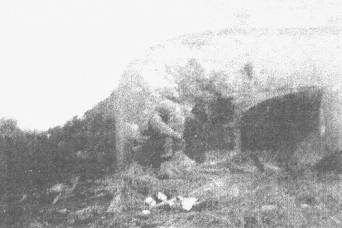
Figure 5-1
One of the Many Siegfried Pill Boxes our T.D.’s Neutralized