FROM
CAMP
BARKELEY, TEXAS
TO
SUSCICE,
CZECHOSLAVAKIA
FEBRUARY
1942 ‑ MAY 1945
A HISTORY
OF
THE 315TH
ENGINEER COMBAT BATTALION
OF THE
90TH INFANTRY DIVISION
BY FRANK
GILCHRIST
JULY 1949
February 1942 Camp Barkeley, Texas August 1943
The
tents of Barkeley snapped and ripped in the cold winds, which swept in from the
higher plains of the west Texas panhandle. The oversize gas heaters warmed the
pyramidals quickly only to have gusts of wind suddenly exhaust the warmth and
refill the canvases with sand laden coldness. Such were the greetings, which
awaited the activation cadres arriving from Fort Leonard Wood, Missouri, in
February and March of 1942.
Officially
born on 25 February 1942, the World War II version of the 315th Engineers
received its cadre of 17 officers from the Engineer Replacement Training Center
at Fort Leonard Wood, Missouri, and 52 men from the 6th Engineer Battalion of
the 6th Division also at Fort Wood at that time.
The
Thunderbird (45th Div-Okla Natl Gd) had been ordered into federal service and
were already training at Barkeley. To the seasoned soldiers the thought of
giving up their cantonment area for some new outfit was most repulsive. But
gradually the shift was made and as the 45th Division moved into another
section of the camp the cadre of the 315th took over the area, which was to be
its base of training operations for a year and a half.
Mess
halls were made ready, supplies were received, training schedules were prepared
and a thousand other details were pursued in preparation for the fillers, which
were to arrive early in April.
During
World War I the 90th Division had been what is now called a "Square
Division" and the 315th Engineers were then a regiment. In the new 90th
which was of the streamlined triangular organization, the 3l5th Engineer Combat
Battalion inherited the history, battle streamers and unit insignia of its
regimental predecessor. The coat of arms, with the traditional red and white
background of the corps of engineers, bore the outline of that famous shrine of
Texas independence, the Alamo. Atop the shield stood a statuette of the pioneer
soldier‑citizen with his muzzle loader signifying the peacetime reserve
status of the organization. The Spanish influence in the southwest was
reflected in the motto "Fabricamos" (we build), and then, for service
in France during War I, the fleur-de‑lis completed the distinctive
insignia under which the 315th Engineer Battalion was activated. Unlike its
predecessor of World War I, which drew its strength from Texas and Oklahoma,
fillers this time came from almost every part of the union with probably the
mid‑western states the best represented.
The city of View, Texas was the railhead, train load after train load of
filler personnel for the division were shuttled into the warehouse area of Camp
Barkeley during the period 1‑8 April 1942. The battalion commander, Lt.
Col. Edwin P. Ketchum, and his staff met the groups, which were assigned to the
315th. The men were marched to the battalion area and for them the war began 8
April1942 on which date basic training was begun.
Later, during the "pay off" in Europe, bronze battle stars
were awarded for campaign participation, but for the "Battle of
Barkeley" many of the men thought that the award could well have been a
miniature jack rabbit carrying a full field pack and a pick and shovel. For
these were rigorous days. Calisthenics before breakfast, close order drill,
tactics, marksmanship, marches with full packs and pioneer and engineer
training all were conducted to prepare the unit for combat operations. Time
after time even during the individual squad and platoon training the battalion
was "abuzz" with rumors that the 90th Infantry Division was
"hot" and scheduled to sail within a month. But time after time the
battalion fought battles over the "high ground south of Elm Creek"
and time after time the unit marched to Hankins Ranch and up to the top of
"Demolition Hill". Running of the obstacle course over by the field
house and the digging of antitank ditches in the area south of the motor pool
were the order of the day.
By 27 June 1942, with the new 315th on a firm footing, Colonel Ketchum
was promoted and was transferred to a higher post. Major Richard G. Stilwell,
the battalion executive officer, became battalion commander and again the
"dope" was that the division would be going overseas right away. But,
instead a cadre school was organized and during the second week of August a complete
enlisted cadre graduated and was sent from the battalion to form a nucleus for
the engineer battalion of the new 104th "Timber Wolf" Division at
camp Adair, Oregon.
Tactical problems now were at regimental combat team level and the
companies were beginning to work with the regiments with which they were
destined to fight the "Kraut" across Europe.
Lake Abilene was the scene of assault "river"crossings, of
bridging and rafting operations and all knew that this training was to become
invaluable in combat. The post engineer rapidly converted the old tent frames
into plywood hutments and the "Battle of Barkeley" moved on.
On 15 September the division changed from an infantry to a motorized
organization much to the initial glee of the infantry troops. Actually the
change had little effect upon the engineers for the battalion was already
motorized to the extent that each man theoretically had an assigned vehicular
space in which to ride. It did, however, add Company D (a reconnaissance company),
and an H & S Company and a bridge train. Both were organized and partially
trained, although never fully equipped.
The
relocation of Texas highways had caused the abandonment and isolation of
several large bridges. Such structures were ideal demolition projects and the
first of several major demolition operations was conducted during October on
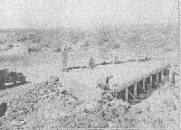
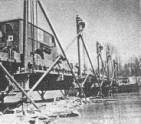
the “Old Red Bluff" bridge across the Colorado River between Lometa and
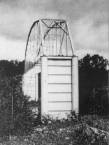
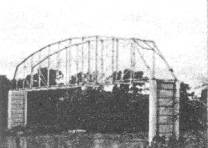
San Saba, Texas. [Figure 1-9, 1-10]
In
coordination with an VIII Corps cavalry unit and elements of the 90th
Reconnaissance Squadron, a tactical problem was worked out which called for a
retreat across and demolition of this 150 ft steel truss bridge. Elaborate
preparations were made. The nationwide drive for collection of scrap steel and
iron added another interesting angle. Governor Coke Stevenson was to be there.
The division commander, Major General Henry Terrell, would witness the problem
and the engineer school at Fort Belvoir, Va., sent Major Theodore F. Astrella
as special demolitions consultant. Newsreel cameras would record the blast and
the whole affair would be broadcast over the popular Sunday Afternoon program
"The Army Hour".
After
a 160 mile motor march to the site the battalion bivouacked in the scrub oak
thickets on the east bank of the river. This was the first real battalion
bivouac and all elements were operating together in the field. Preliminary
special classes in demolitions were conducted, tactical problems were executed
but during the two days of preparations all attention was really focused upon
the hour when the blasting machine handle would be twisted and the bridge would
fall.
Sunday morning was clear and by noon all was
in readiness. Bunkers for the cameramen had been built of sand bags. Telephone
lines were tested, firing circuits were checked, dignitaries and nearby
townspeople assembled on the new bridge up‑stream from the old red bluff.
As the appointed hour drew near, everything was in readiness and families of
many of the men of the battalion were at their radios throughout the nation
listening to the very special program on "The Army Hour".
The problem began. The covering force
withdrew while dynamite charges in the water simulated artillery fire. The
situation was explained to the assembled audience and read into the NBC
microphone. Then, with precision timing, the Old Red Bluff Bridge was neatly
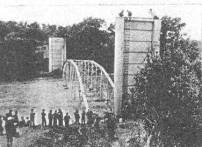
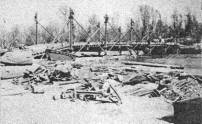
clipped and dropped into the swirling Colorado. [Figure 1-11]
But things weren't so well with the families
at their radios for (so the story goes) a bird hunter between the bridge and
San Saba had clipped the circuit with a very ill‑timed shot. NBC called
and called in vain but the program was being fed into a dead microphone. Later
in the program the successful demolition was reported to "The Army Hour"
listeners but the dramatic blast had been lost.
Heavy rains on the upstream watershed had
caused a minor rise of the river before the demolition but after the bridge had
been dropped across the channel the water continued to rise rapidly bringing
with large amounts of debris. This burden of
logs and trash piled up against the bridge and created such a pressure
against it that during the night the bridge was overturned and completely
submerged. This began the 3l5th Engineers long record of experience with
flooded streams. The salvage of steel from the bridge was an important part of
the problem but the river continued to rise making underwater cutting charges
unprofitable. The battalion returned to Camp Barkeley. Later, after the flood
had subsided, Company B, with extra acetylene torches, demolition charges and
power cranes returned to cut up, remove and salvage the steel.
Another
of the bridge demolition projects was located south of the city of Sweetwater,
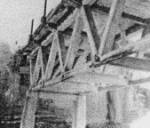
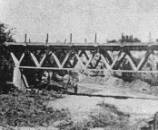
Texas. Here, in the sheep pasture, was an old reinforced concrete queen truss
bridge, [Figure 1-6, 1-7] which was easily demolished during a night tactical
problem. This time, however, wide publicity had not been given the project.
Sabotage and rumors of sabotage had been claiming the newspaper headlines for
several weeks. That night when the bridge blast rattled windows in Sweetwater
the residents were quite willing to believe a vicious rumor that saboteurs had
destroyed the municipal water supply plant of this city where threats of water
shortages were a constant fear. But this time the radio system worked and the
population was quickly reassured.
During the months of December and January the
lettered companies with their respective combat team regiments, and later the
battalion as a whole, completed the regimental combat team and divisional unit
training phases in the mesquite and juniper covered hills of Barkeley maneuver
area. These problems were conducted under simulated combat conditions. The
weather was extremely cold at times, but fires and other comforts, which a
soldier in combat is denied were taboo here also. The men were in fine physical
condition each having gained an average of 10 pounds and were beginning to feel
that they now were ready for real soldiering.
The men knew their individual jobs, they had
learned to work together as teams and were ready for some big‑scale
maneuvering. On 26 January 1943, the battalion moved with the division 500
miles by truck over ice and snow covered highways to the vicinity of Leesville,
Louisiana.
During the next two months the division was
engaged in third army maneuvers against the 77th Infantry Division. The piney
woods of East Texas and the densely thicketed swamps of the Kisatchee Forest
along the Sabine River, the burned over wasteland of Peason Ridge, the five
bridges west of Anacoco, the mud without bottom, the assault crossing of the
river and the bridging at Toledo Ferry and at Burr Ferry all gave the 315th an
inkling of what was to come.
Here, with its 183 vehicles, the battalion made
blackout marches and many were the damaged transmissions, oil pans, brake lines
and steering trains, for the knee high stumps made excellent anti‑
vehicular obstacles in the inky darkness. The real engineer‑pioneer
problems were, as always, the roads. Hundreds of yards of corduroy were laid,
bridges were repaired and in one case, where a Sherman tank tried to cross a
class 2 structure, the battalion completely built a bridge.
During the advance against the 77th the
infantrymen were ferried across the Sabine. Footbridges were built and then
pontoon bridges were erected only to be "knocked out" by cub planes
dropping small paper sacks of flour. In their retreat almost every bridge was
declared destroyed and, in order to fulfill the maneuver requirement rules,
timber trestle bents were erected alongside to simulate a portion of the repair
work which would probably have been necessary in real action.
But soon it was the 90th’s time to retreat
and in doing so the 3l5th covered strategic members of most bridges with
"wooden TNT" blocks connected together with "Marlien
primacord". The delaying action allowed the division to barely escape to
the Texas side of the river where it prepared to defend the river line.
During the night before the dawn on which the
77th was expected to make its assault crossing a specially selected team of the
3l5th played havoc with the enemy's lines of communication. After crossing to
the "enemy side" in rubber boats under cover of darkness, the team
made its way through the lines and to a point several miles to their rear to
attack a vital bridge on a main road. Although well guarded by the
"blues" the team stealthily approached and attached their charges
underneath the bridge while the guards stood watch above. The "TNT"
was primed and the "fuse" was lit and the umpire declared
"out", the bridge over which a major portion of the 77th was soon
scheduled to pass. A portion of the team was captured in the melee but others
escaped and returned in the reconnaissance boats to report the success of the
mission.
The battalion made an excellent record in
Louisiana and later in Normandy and across Europe the maneuvers against the
77th Division were recalled as probably the most valuable single period of
training.
When
the battalion loaded its equipment in preparation for the Louisiana maneuvers
it was good bye to Texas ‑ especially to Camp Barkeley for surely the
division would soon be ready and would move directly to an overseas staging
base. But, 2 April 1943 found the battalion and the division at Camp Barkeley.
Experience had demonstrated that the infantry division organization was the
better for the probable theaters of operation so the 90th was reorganized. This
time it was from a motorized division back to an infantry division and within
the 315th Engineer Battalion Company D and the bridge train in H & S
Company were deactivated. Personnel of these organizations were transferred to
other units within the battalion.
Training continued with stress being placed
on physical conditioning and combat firing. For use by all units of the
division, the battalion built a mock Nazi village through which street fighting
problems were run. For combat team problems in the assault of fortified
positions the battalion constructed, in the artillery impact area, a mock‑up
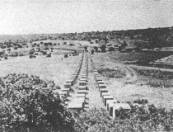
section of a fortified area complete with camouflaged concrete gun embrasures,
concrete anti‑tank obstacles, [Figure1-8] anti‑tank ditches and
wire entanglements. Then, in teams with the infantry, elements of the battalion
engaged in the breaching of the fortifications using pole charges, satchel
charges, bangalore torpedoes and flame throwers. By now it seemed that the
battalion's future theater of operations was fairly well defined. But again
immediate overseas shipment was delayed and the nearest thing to combat for the
battalion was the fighting of savage brush fires and the repairing of fences on
Hankins Ranch.
As
the month of August drew to a close most of the men thought that the time had
come for them to prove themselves. They did not know, however, that the army
was not sparing any expense or being rushed when it came to readying for combat
one of its crack units. So, in early September 1943 the division was loading
and speeding westward by train with the 315th Engineer Battalion leading the
way to complete construction work on the division camp in the California‑Arizona
maneuver area.