28 March 1945
Central Europe 9 May 1945
In
the streets and alongside the levees of Muhlheim the assault boats were laid
out in the darkness. The 315th was supporting the 358th Infantry while just
downstream at Rumpenheim the 150th Engineers were making similar preparations
for the 357th Infantry. As the assault hour 0330 on 28 March approached all was
unusually quiet along the riverfront. Boats were carried over the dikes and
silently launched into the stream. The infantrymen were loaded, paddled across
and the engineers returned the boats for the second, then the third loads.
Still no shot had been fired. Then, as the first light of dawn dimly
illuminated the fog rising from the river there was a brief but violent
firefight with a detachment of Hitler Youth OCS cadets in the village of
Dornigheim. Small arms fire raked the crossing sites as Company C rapidly
pushed out and completed a footbridge. Artillery fire from batteries in the
Taunus Hills on the northern outskirts of Frankfurt bracketed the area but the
work went on.
The
359th Infantry streamed over the footbridge and then Company C built support
rafts and carried the tactical vehicles across. The corps engineers were soon
at work on a heavy pontoon bridge at the Muhlheim‑Dornigheim ferry site.
By mid‑afternoon the bridge was complete and the 6th Armored was roaring
across. In less than twelve hours two regiments had been ferried over in
assault boats, a third crossed on a footbridge, tactical vehicles had been
rafted across and now armor was streaming over and into the heartland of
Germany.
On
30 March the division advanced 25 miles, the next day 30 miles. Town after town
displayed the white banner of surrender and nowhere could Nazis be found. The
German civilians were all peace loving people who had always hated Hitler and
his crowd and who loved the Americans passionately. There were a few road
blocks but the civilians were eager to help remove them. Many of the great
masonry arch bridges on the autobahns had been demolished but most could be
bypassed. On and on – it was the same each day – a few skirmishes, a few
roadblocks and bypasses, but mainly it was a matter of racing on into the hills
of Hessen.
On
1 April one of the H & S Company reconnaissance teams was captured while
reconnoitering a bridge site near Heimboldshsn the team later escaped and on 3
April bridges over the Werra River were built at Widdershausen, Dondorf and
Vacha.
This
area of Germany was a mining and manufacturing center and it was at Merkers in
a salt mine that the 90th captured the entire German gold reserve. One hundred
tons of gold bullion and millions of dollars in currencies of many nations were
captured along with priceless art treasures which had been looted from the art
centers of Europe. The 357th Infantry was detailed to guard the treasure while
the main body of the division pushed ahead to Bad Salzungen where a large group
of German diplomats were captured in a very plush hotel overlooking a crystal
lake.
The bridge across the Werpa at Bad Salzungen
was captured intact and the demolition charges were removed. But as the 90th
pushed on a fourth bridge over the Werra was built between Immelborn and
Barchfeld as the division raced on into the mountains of Thuringia amid a solid
stream of liberated slave laborers.
At
Zella Mehlis on 9 April the Walther small arms factories were captured. It
seemed that there were enough pistols and shotguns and rifles there, in various
stages of manufacture, to have completely armed several divisions and needless
to say, most of the visiting Americans helped themselves from the stocks of
completed weapons.
This
rugged country was ideal for a determined defender. The mountainous roads could
have been cratered or mined and hundreds of bridges could have been destroyed
but instead only a few abatises blocked the way. The 90th moved on 10, 20 and
sometimes 30 miles a day.
At
Hirschberg, near the great hydroelectric reservoir, the Saale‑Stau See, a
bailey was built over the Saale. At Blankenstein a floating bridge as pushed
across and the division rolled on.
Hof
fell and elements of the division, duly accompanied by photographers and press
correspondents, crossed into Czechoslovakia on 18 April 1945. The 90th had been
the first to slice completely across the German nation. Turning now to the
south and moving parallel to the Czech western border the division slashed on
through Marktredwitz, Tirschenreuth and Neustadt where a bailey was built
across Waldnabb River on the 23rd
This
was near the huge Wermacht training center of Graffenwohr and a few of the
diehards (perhaps from the school) made a last ditch stand behind abatis in
which antipersonnel mines had been placed. This sudden return of mine warfare
caused several engineer casualties but soon the division had slashed on through
this zone.
The
infantry had liberated American prisoners of war at Fuschmill and at
Flossenberg a huge concentration camp was captured. Here the bodies of former
inmates were stacked like cordwood awaiting transportation via a special
inclined rail car down into the furnace ovens.
On
4 May the entire German l1th Panzer Division surrendered unconditionally to the
90th. Moving in their own 700 odd vehicles Germans moved in under the white
banner, were disarmed and set up in their own PW cage.
On
the next day the division turned again into Czechoslovakia to open the Regen
pass through the mountains, to allow the 4th Armored to rush through, then
motorize and make a dash for Prague. Vast forests lined the roads and the
winter's snow still capped the places along the route through Zwiesel to
Suscice as the division pushed through the Sudetenland. A few trees had been
felled across the road, a few mines had been scattered on top of the paving and
near Ludwigsthal. A bridge over a swift mountain stream had been demolished.
The gap was quickly spanned with a bailey and the advance continued only to be
halted suddenly on the morning of 7 May. A message of historic importance was
being relayed to all units! The German high command had signed an unconditional
surrender.
With
the battalion CP and H & S Company at Mestys Zelezna Ruda, and the lettered
companies with their respective combat team regiments still deeper in liberated
Czechoslovakia, the combat history of the 315th Engineer Battalion ended – a
history which began on the beaches of Normandy and wound through one thousand
miles of hedgerows, craters, mines and road blocks and rubble, across eleven
major rivers and countless minor streams – the 315th Engineers had cleared the
routes half way across Europe and stood triumphantly at last facing the
Russians on the liberated soil of Bohemia.
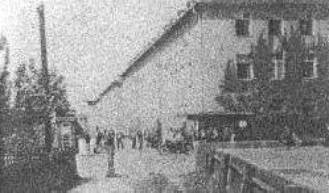
Figure 9-1