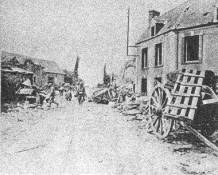
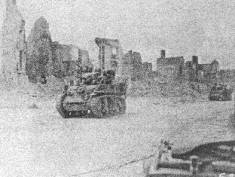
6 JUNE 1944 NORMANDY 27 JULY 1944
During
the first week in March, officers of the advance detachment had been briefed on
the invasion operation. In the "Bigot for Neptune" room at the King
Edward school in Bristol the plans for the employment of the division and the
315th were being made. On the large scale map models, the assembly areas were
selected and initial missions were planned. Then as "D" day
approached, and the "Bigot" room was moved to Heath Camp at Cardiff,
other officers were briefed and map sets and orders were assembled.
Now,
aboard ship, the briefings were extended to the company and platoon levels and
the preparation phase was ended. Next would be the real thing.
The
short voyage across the channel was a weird affair in many ways. On some of the
ships the public address systems played the latest recordings from the Hit
Parade while the men basked in the warm sunlight and played cards for the new
French "invasion money”. On another ship the men crowded the rail to watch
a running battle between a destroyer and a German submarine. But regardless of
the diversionary activities most thoughts were on the job, which lay ahead.
As
the convoys anchored off shore the sight was indescribable. In the chill of the
dawn as far as one could see the ocean was infested with ships. [Figure 5-1,
Figure 5-2] There were battleships, liberty ships, luxury liners converted into
transports, landing craft and even former yachts, river boats, tugs and barges.
All were loaded to capacity with men, equipment and supplies. The battle wagons
were firing round after round of high explosives into the coastal
fortifications on the Isles de St Marcouf. In the sky the air force was busy
with the Luftwaffe. Burning ships could be seen in the distance and frequently
a flaming plane streaked downward and crashed into the water.
Then
the LCVP's pulled alongside; cargo nets were lowered and the men in their gas
impregnated clothing with their packs, life belt, weapons and tools and other
equipment scrambled over the sides and down into the pitching and buckling
little landing boats. Even before the craft thudded ashore and dropped their
front doors the litter and debris of war could be seen in the water and on the
beach. [Figure 5-3] Overturned boats, shell shattered jeeps and personnel
belongings were strewn over the sands. A floating body, another grotesquely
half covered in the sand and still others lying in rows covered with blankets ‑
like men in formation for drill ‑ this was war for the 315th.
Get
off the beach! [Figure 5-4] Keep moving inland! Have you seen anything of
Company K? Where are we on this map? Where is the CP? Where are the front
lines? Yet ‑ amid the confusion the units moved inland – across the
inundated area, past the smashed gliders, past the bodies of airborne troops
still hanging by their parachute shrouds in the trees, down the hedgerow
banked, equipment‑littered roads to the assembly areas.
A
portion of Company C hit the beach on D-Day with the 359th Infantry but the
main body of the company was on the Susan B. Anthony, which struck a mine and
sank off shore within two hours on the morning of 7 June. Only one man was
injured. After being picked up by a mine sweeper, then transferred to a British
destroyer, thence to an LCT the troops got ashore and joined the advance party
with the 359th Infantry in the vicinity of Beuzeville‑au‑Plain. The
company had been attached to the 359th infantry and the regimental team was in
turn attached to the 4th Infantry Division for the assault phase. So, Company C
was the first unit of the 315th to see action, first to draw blood from the
kraut and also first to sustain battle casualties.
By
1245 on 8 June the marching parties of Companies A, B and H & S had waded ashore
and were on the march to the first bivouac area ¼ mile west of Adouville‑la‑Hubert
and near the town of Ste Mere Eglise.
The
battalion aid station was established with the CP and the aid men were
integrated into the platoons of the lettered companies where they were to
perform heroic services during all of the battles, which lay ahead. Vehicles
were unloaded on top of the lighter craft and shuttled to the beach where the
drivers waded them ashore, performed essential de‑waterproofing and drove
them into the beach to join their units. The reassembly mission was practically
complete when the first field order was received from division on 9 June.
The
90th Division will attack! This phrase, which was to be heard over and over
again during the next eleven months of combat, signaled the beginning of the
pay off for which more than two years of preparation had been made.
Initially
the companies were attached to their respective combat team regiments. Company
B saw its first concentrated enemy action on 10 June in an ill fated attempt to
destroy a bridge over the Douve River on the division's left flank. After
advancing practically unopposed for about one mile west of Chef du Pont, the
1st platoon, with a platoon of the 358th Infantry emerged from the walled
protection of the high root‑reinforced, earth‑banked hedgerows on
to a causeway over the inundated flood plain of the river. At the south end of
this fill lay the kraut held village of Beuzeville la Bastille, and just short
of the village was the masonry bridge to be destroyed. Boldly the troops
advanced in the bright sunlight and all seemed unusually quiet until suddenly a
flare was fired from a building followed by the crack of a kraut sniper’s
bullet and then a barrage of heavy machine gun fire. The position on the
causeway was untenable in face of the Wermacht firmly emplaced in the stone
walled buildings overlooking the bridge. Efforts to place our artillery fire on
the defenders failed when the observer's radio was shot out. The men lay prone
in the grass and water as fire raked the area and Company B suffered its first
combat casualties. Slowly, as on the infiltration course at Barkeley, the men
recoiled from the shock of the withering blast. Gradually, under the continuing
heavy fire, the men crawled to the shelter of the hedgerows. There, the mission
was changed and the platoon dug in, emplacing its machine guns and bazookas to
repulse any enemy attack.
Meanwhile,
in other portions of the division sector, other units of the battalion were
clearing mines, [Figure 5-5] constructing access roads for the infantry supply
vehicles, dragging burned out vehicles and dead animals from the roads and
breaching hedgerows so that tanks and tactical vehicles could move from one
tiny field to another. The headquarters reconnaissance teams were engaged in
charting the roads, trails and bridges in searches for clear routes for the
advance. The S‑2 and ADE sections procured and distributed 42,000 maps.
Three water supply points were operated. The S‑4 Section built an
improvised shower unit at Chef du Pont and opened it for use by all troops in
the area. The S‑3Section prepared and distributed information bulletins
on new types of German mines, which were being found. The motor section
manufactured 2400 mine signs. Division forward CP's were dug in by bulldozers
before occupancy. Houses to be used as CP's were checked for booby traps and
throughout the division zone camouflage discipline was checked and corrective
measures recommended.
During
these days dawn came about 0400 and darkness seldom settled over the damp
clammy countryside before 2300. The nights seemed to be only short interludes
during which the German reconnaissance planes could roam. The one, which always
came over just after dark, was dubbed "Bed Check Charlie". The
unsynchronized moan of his motors was unmistakable and drew the fire of every
weapon on the beachhead. The skies were filled with the criss-crossing of
tracers but on the ground the apple orchards and narrow lanes were filled with the
high rate staccato fire of the burp gun and the crack‑whiz of the
"88".
In
a violent battle on 10 June, Company A moved with the 357th Infantry in an
attack on Amfreville, which continued for two days until its capture on the
afternoon of 11th. Here advances were measured in yards and each tiny field,
grazed by machine gun fire and pocked by mortars, took its toll. The regiment
suffered heavy casualties and after repeated attacks and counterattacks on the
next village of Gourbesville, Company A was assigned the mission of separate
attack on 13 June. The company moved up behind a predawn barrage but at 0500
just outside the town heavy machine gun and mortar fire caught the company
moving through an orchard. Five were killed, three were wounded and the company
was forced to defend its position. Further attacks with elements of the 357th
Infantry on the 14th were unsuccessful! And the action resulted in five
additional, men killed and 14 others wounded in Company A. Finally, on the 15th
Gourbesville fell. At 0900 on 16 June Company A was released from attachment.
The
first replacements, a group of 99 men, joined the battalion and the individuals
were assigned to the various companies. Kitchen trucks arrived with the rear
echelon detachments and the first mail from home was received. The battalion
had withstood its baptism of fire and was now set to fight or work and often do
both at the same time to clear the way for the 90th.
Mine
and debris removal continued as the number one engineer problem and this work
assumed gigantic proportions when after days of shelling and bombing the town
of Pont l' Abbe was taken. Tons of rubble were pushed from the streets to open
them for traffic. Mines and dud shells were collected and detonated and then
again the engineers were off for an infantry mission.
Another
division had cut the Cotentin Peninsula and the drive on Cherbourg had begun.
To prevent the Germans from leaving or entering the peninsula the 357th
Infantry, with Companies A and B of the 315th Engineers (attached on 22 June)
moved by motor to the general line Neuvilleen Beaumont to Hamefax. Here the
engineers installed road blocks and mines, manned outposts along the escape
routes and incidentally discovered a cleverly camouflaged "V bomb"
launching site. Company B was relieved on the 27th and Company A on the 29th.
As these companies were released they moved with Company C and H & S into a
battalion assembly area near Groult to prepare for the next action ‑- an
attack to the southeast.
On
2 July the drive was launched and the battalion engaged in the normal mission
of clearing mines, debris and blocks from the roads and trails as the infantry
pushed forward toward Pretot, St Suzanne, St Jores, Lithaire and the Foret de
Mont Castre. Progress was slow. Every foot of ground was fiercely defended by
fire or by mines or by both; and it was in a narrow sunken trail near Pretot
that the first major equipment casualty occurred.
A
tank had hit a mine, was disabled and blocking traffic. Mine detectors had been
used to search the area and many tellermines were removed. Then the H & S
Company D-7 dozer was brought in to open a bypass around the tank. No one will
ever know exactly what happened. The explosion was not that of a single anti‑tank
mine or of even several anti‑tank mines but was more like the detonation
of a large cratering charge. The mighty D‑7 was thrown over on its side
and its bottom torn out. A tread was crazily wrapped around the superstructure
and the driver tossed off into a field and seriously wounded. The kraut was
taking a heavy toll in equipment too.
Nearby
a platoon of Company C was removing mines and booby‑traps. A passing
soldier set of an “S" mine seriously wounding three of the engineers.
The
division was fighting desperately at Beau Coudray and on the slopes of Hill
122. The German army was making a furious counterattack trying to break through
and hurl the invaders back into the sea. Again the engineers went into the
line. First Company B was attached to the 358th Infantry at 1200 on 7 July and moved
into a defensive position on Hill 122. Then at 2400 the entire battalion was
attached to the 358th Regiment and moved to Hill 122 and the Foret de Mont
Castre. Here, amid the ruins of the fortress, Camp de Cesar, (built by the
roman emperor over 2,000 years ago) the battalion fought alongside the 358th
Infantry as the provisional battalion mortar platoon [Figure 5-6] was moved
into position to repulse attack after attack. Composed of a squad from each of
the lettered companies and equipped with six captured 80mm mortars the
"engineer artillery" laid down barrage after barrage from a well
stocked, captured, Kraut ASP.
On
July 11th the attacks were beaten and the infantry launched a successful drive
moving forward through the dense underbrush of the forward slopes of the Foret.
Engineer casualties had been 5 killed and 18 wounded when, at 0930, the
battalion was released from attachment.
Over
a month of fighting had passed since the beach landings. Now, atop Cesar's
fortress on Hill 122, it seemed that the division had fought at least half
across France. But on that morning of 11 July the sun broke out and as the
swirling mist lifted, even without binoculars, one could see the white sands of
the Utah Beach beyond the weird lovely lowlands of stately moated chateaus and
rich flowering pastures.
Craters,
mines, knocked out vehicles and dead cattle blocked the roads. As the division
pushed forward the engineers worked day and night to clear the way. By the 15th
of July the river Seves was reached and the division halted briefly for
reorganization.
Now
the river Seves is not a large river. In fact, in America it would probably not
even have a name and surely would not be called a river. Yet, this brook with
its wide grassy marshes, had been carefully developed as a formidable obstacle
by the Boche. Machine guns to graze the meadow, 88's and panzerfausts to cover
the destroyed bridges ‑- all had been well dug in and camouflaged. Time
and time again the troops assaulted the positions and time and time again a
sheet of impenetrable fire was placed along the Seves. All night long the
artillery roared overhead. Both the ''incoming" and "outgoing
mail" rumbled over the orchards like fast freight trains speeding through
the night. Never before had the units been subjected to, or delivered to the
enemy, such sustained masses of fire.
It
was only after 10 days of fire and counter fire that the German position was
softened but then a strong counterattack appeared to be developing and Company
B was rushed into a position astride the main north‑south road to
Periers. Here at St Patrice de Claids the company dug in, sighted its weapons
and ran its telephone lines to the outposts. But the attack didn't develop and
on 27 July the division broke through the kraut defenses. Companies B and C
spanned the Seves with steel treadway sections near St Patrice de Claids and at
St Germain sur Seves.
The
race was on!
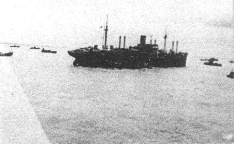
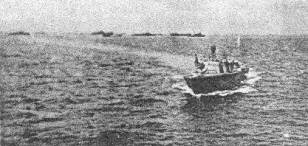
Figure 5-1 Figure 5-2
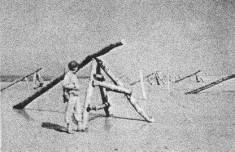
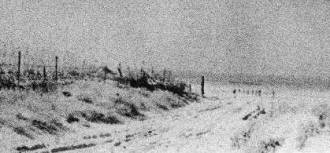
Figure 5-3 Figure 5-4
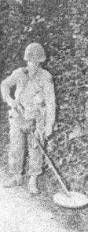
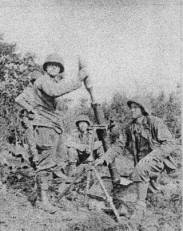
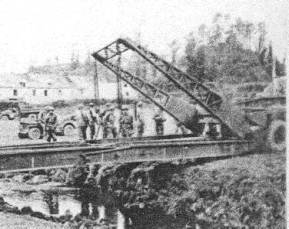
Figure 5-5 Figure
5-6 Figure 5-7
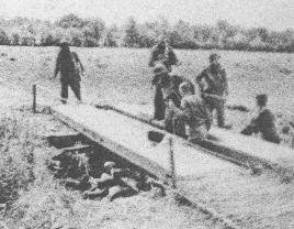
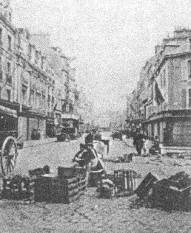
Figure 5-8 Figure 5-9
Figure 5-10 Figure
5-11