April
1944 England – Wales May 1944
In the meantime the advance detachment had
staged at Fort Hamilton, sailed aboard the "Queen Mary" on 1 March
and had arrived in Greenock, Scotland on the 6th. A Scottish band, complete
with bagpipes and kilts, had played ancient tunes and the ultra‑modern
"Deep in the Heart of Texas" as the 90th Division advance guard
entrained for Birminghan in the midlands of England.
Initially stationed with the division
headquarters group in the old "King Edward School" on Bristol Rd. the
advance detachment made plans and preparations for the reception, training and
the equipping of the battalion which was soon to arrive.
In the Mersey River channel off Liverpool, England,
the "John Ericsson" arrived at 0800 on 8 April 1944. Debarkation was
made on to the floating docks during 9‑10 April and the companies
immediately entrained for their respective camps.
Upon arrival of the battalion in England
Major Carlton L. Nelson, who had been with the advance detachment, took over
the command from Major Sibeck. Then, on 12 April 1944, Major Nelson was
transferred to the G‑3 Section in Division Headquarters and Major Frank
Gilchrist was appointed battalion commander.
Division headquarters was located in
Birmingham and the troops were dispersed in five tent camps on an approximate
50 mile radius west of the city. Company A went to Davenport Hall in Northern
Shropshire with a portion of the division artillery. Company B was assigned to
Kinlet Hall near Kidderminster with a part of the 357th Infantry. Company C
moved into Camp Stanage near Knighton, Radnor, Wales. Battalion Headquarters, H
& S Company and the Medical Detachment were established with the 359th
Infantry at Herrington Park in Herefordshire near Leominster.
Again the 315th Engineers became post
engineers in addition to their other duties. Although some of the camps bore
fancy designations as parks, halls and commons, the living quarters for the
battalion were all of tentage. The names of Davenport, Kinlet and Berrington
had all been adopted from the titles of the old English estates on which the
camps were situated. Ablution huts, kitchens, mess halls, drying rooms and
headquarters buildings were all of the prefabricated quonset or nisson type.
British and American troops and British contractors had done good jobs but
again, as in the case of Camp Granite in the desert, work had stopped prior to
completion. The 315th Engineers again went into the construction and utility
business. Each engineer company did work at its respective camp and special
details were sent to Stuart Common, Camp Gatacre and King Edwards School, the
other division camps where no engineer troops were stationed.
But
it was soon realized that the stay in England would not be long and the post
engineer work was restricted to the absolute essentials. The battalion
continued its physical conditioning, received and processed new equipment and
supplies. Experimented with hedgerow breaching on Clee Hill near Tenbury,
constructed a floating bailey bridge on the river Severn [Figure 4-1] and some
men and officers observed the pre-invasion practice landings at Slapton Sands
near Torqay on the channel coast.
By
the first of May the entire battalion had been re‑supplied with its full
T/O & E allowances and schools were conducted in the waterproofing of
vehicles.
During
the stay in England, the men were granted short passes to the nearby towns
where they learned to know their British Allies over the warm ale and beer of
local pubs. The soldiers, however, were not here for fun, but for the most
serious business they had ever undertaken and they knew it. Each one privately
wondered and guessed about D-Day and the part that the 90th might play in that
or later landings. The wide field of speculation was narrowed considerably when
on 11 May Company C loaded for combat
and moved from Camp Stanage by motor convoy to Cort-Y-Gol!en near Crickhowell.
Then, on the 13th, Battalion Headquarters, H
& S Company, and the Medical Detachment moved from Berrington Park to Heath
Camp at Cardiff. On the same day Companies A and B moved from Davenport and
Kinlet to Camp Bulwark near Chepstow. All elements of the battalion and the
division were now on the southern coast of Wales along the Bristol Channel. It
was here that the men had their first experience with enemy planes and bombs.
Although the attack was not directed against any of the battalion's camps, but
at a coastal city several miles away, the exploding bombs sounded as though
they were falling in the next field.
During the two weeks in this so called
"transit area" all mess, fatigue and other details were handled by
service troops. Physical conditioning was continued, equipment and supplies
were rechecked, vehicles were waterproofed and the personnel in each company
was divided into 3 groups. The rear echelon group which included the clerical
and mess personnel with their equipment moved to a central division rendezvous
point at Bournemouth. The vehicular group consisting of drivers, assistant
drivers and maintenance personnel prepared to carry ashore all supplies and
equipment which were to be needed for the initial operations. Some were to
carry explosives, others mine detectors and still others communication equipment.
All of this in addition to full packs and K rations for 3 days. Final practice
in climbing of cargo nets was conducted and still there had been no news
announcement that the sea borne assault on "Festung Europa" had
begun. It looked as if the old 90th of
Barkeley, Granite and Dix might be loading up for one the first assault waves.
During the 2nd, 3rd and 4th of June the companies moved to their designated "hards" and loaded aboard with the vehicular and marching parties of each company on at least two different ships. Elements of the battalion were on nine individual vessels and there was much wondering whether it would ever reassemble as the convoy formed up in the Bristol Channel on 5 June 1944.
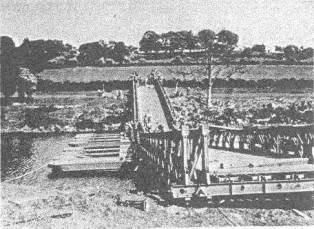
Figure 4-1