January 1944 Fort Dix, New Jersey ‑ N.Y. POE March 1944
No, this was the real
thing.
For the first
time in nearly two years of training the battalion lived in regular furnace
heated barracks each of which contained a shower section. Though the
"modified field ration" used in the desert had been much better than
some that lay ahead, the garrison ration of Dix was really
"something".
Much of the
heavier equipment had been turned in before the battalion left the desert and
now a large portion of the remaining supplies and equipment were turned over to
Fort Dix supply installations. Complete sets of new equipment were already
overseas and the battalion would be re‑supplied in the theater of
operations, but individual clothing and TAT items were checked and double
checked.
Time was now
devoted to making each man POM qualified. Firing was again the major item and
again combat problems were run through a mock village. Since most of the
battalion vehicles had already been turned in. The Fort Dix narrow gage railway
was used to transport the troops to and from the various ranges.
The prerequisites
for overseas movement fortunately included the items of a furlough for each
man. With about a third of each company off on leave at all times the farewell
visits were soon completed. On 15 March, when the battalion received additional
replacements, the unit was at full strength and ready to go.
At a final
review the division received a large flag of the "Republic of Texas"
from a group of War I veterans of the 90th. The Texas delegation also presented
a box of "Sacred Texas Soil" in which the flag staff was destined to
be emplaced, more than a year later, at the Wermacht Training Center at
Graffenwohr, Bavaria.
On the morning of
18 February 1944 the division advance detachment had left Fort Dix for the POE.
Included were four officers and men of the 315th Engineers who were to make
preparations for the battalion's arrival overseas.
On 1 March Major
Claire E. Groves, from the 69th Infantry Division and Major Leonard G. Sibeck,
from the 86th Infantry Division, joined the battalion. Major Groves succeeded
Major Tabor as battalion commander and the latter was transferred to Camp
Pickett, Va. on March 4, but on 11 march Major Groves was transferred to Camp
Butner, N.C. and Major Sibeck assumed command. On 17 march the battalion
departed for Camp Kilmer and the N.Y. POE and after five days of processing, it
entrained for Jersey City where it was shuttled by ferry to the Staten Island
terminal on 21 march 1944.
This was it! The
battalion was on its way! But again troubles beset the unit. This time it was
engine trouble and the "John Ericsson" was forced to leave the convoy
at 2000 hours and return with an escort to enter dry dock at the foot of 23rd
street in New York. Here within sight of the bright lights of the city the
battalion was to wait on board a ship in a dry dock for four days while one of
the mighty diesels was being repaired.
A new convoy was
forming on 28 March and the "John Ericsson" was floated again to sail
at 1030 for a second attempt at crossing the Atlantic.
From a seaman's
point of view the 10 day voyage was probably without particular incident, but
many of the land‑lubbers spent considerable time feeding the fish and expected
to be sent to the bottom most any day by u‑boats.
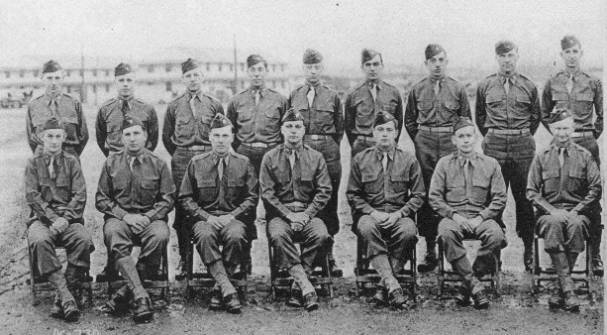
Figure 3-1
Lt Steinborn,
Lt Poczik, Lt Cowan, Lt Denbaigh, Lt Keagy, Lt Craven, Lt Campbell, Lt
Ackerman, Lt Wimmet
Lt Bauer, Lt Midyett, Capt Thompson, Capt
Perry, Capt Evans, Maj Gilchrist, Maj Tabor (CO)
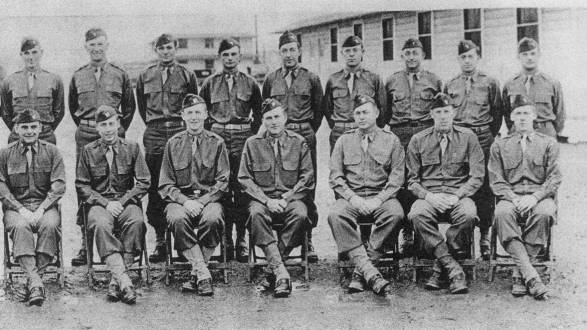
Figure 3-2
Lt
Cooper, Lt Brannick, Mr De Gasparis, Lt Horne, Lt Yuska, Lt Starr, Mr Stubblefield
Maj
Nelson, Capt Rhodes, Capt Stromquist, Capt St Clair, Capt
Symes, Lt Jacobson