September 1943
Camp Granite,
California December 1943
Although
the fighting in North Africa had ended by this time, training in the desert was
considered highly valuable from the standpoint of physical conditioning, moving
and maintaining direction at night, operating efficiently with limited water
and food supplies and for logistical experience. Camp Granite was a tent camp
located in the Mojave Desert of southeastern California. Forty miles east of
Desert Center and about the same distance west of Parker, Arizona. This new
base of operations for the 90th was situated on a broad sand and volcanic rock
plain at the base of a southern spur of the Granite Mountains.
An
engineer general service regiment had been working on the camp for several
months but had been transferred to another job leaving the streets only
partially defined, the pumping system only partially installed, a few of the
shower houses completed and most of the kitchen tent frames and latrines
constructed. An advance party from the 315th Engineer Battalion had been on the
site approximately two weeks when the battalion arrived at the Freda railhead
on 3 September 1943. Construction plans had been made and as soon as the
battalion had pitched its pyramidals, work assignments were begun, streets were
graded and marked, shower houses were completed, plumbing was installed and to
Company A went the honor of the layout and construction of facilities for
division headquarters. But the completion and operation of the water supply
system was to be the big problem.
Thin
walled steel pipe had been laid from the partially completed pumping station to
a partially finished elevated wooden storage tank but many long sections of the
line had been left uncovered. During the day the sun beat down and heated the
dry desert air to 115 degrees. In this heat the pipe expanded and buckled
around in the trenches like a huge snake. Then, when each cold desert night
suddenly closed in, the rapid contraction of the lines opened countless minor
and many major breaks in the welded joints.
Fortunately
the actual source of water was plentiful. From Parker Dam on the Colorado River
50 miles to the east, water flowed past Camp Granite in the Los Angeles
metropolitan aqueduct. A huge fenced-in trapezoidal concrete ditch running some
300 miles into Los Angeles. This open channel was tapped at a siphon under the
Parker‑Desert Center Highway near the point where the flow entered the
Iron Mountain Pumping Station of the aqueduct system. Two gasoline motors of
doubtful vintage driving a five stage centrifugal pump, of equally doubtful
origin, constituted the primary equipment with which the H & S Company
motor section was to supply water for the entire division camp. The distance
from the intake to the elevated storage tank was approximately five miles and
the lift was about 350 ft. Time and time again the pumps heaved the load up the
main line and time and time again a joint would split and the system would have
to be drained.
Finally,
after much sweating, swearing and all night work, water was lifted to the
storage tank but again an adequate camp supply was to be denied. The hot dry
air had so thoroughly dehydrated the staves of the tank that even after careful
preliminary caulking the water came out the cracks just about as fast as the
pump could put it in. Furthermore, the downpour of water from the tank bottom
scoured the ground and threatened to undermine the concrete foundations.
During
all this time the infantry troops in the lower end of camp had water but the
artillerymen on the high side of Granite did much plain and fancy swearing at
the 315th "Post Engineer Battalion".
Gradually
the staves began to swell and as the leaks diminished the water level assumed a
more respectable height. Within three weeks, with major construction work
accomplished, the battalion turned again to the training for the more important
missions ahead. A small crew of H & S men continued to maintain and operate
the camp utilities but the bulk of the battalion was again off on another round
of combat firing. Anti-aircraft firing at towed targets and radio controlled
miniature planes and training with the regiments in RCT problems. During the interim at Camp Barkeley between
Louisiana maneuvers and the movement to the desert, the battalion had conducted
a series of squad leadership problems. The squads had made individual marches
on given azimuths through the Barkeley thickets from one control point to the
next. At each they received new instructions, additional rations and had
marched off to another point with another squad mission. The last day of each
of the squad problems involved the inflation of rubber boats and the crossing
of Lake Abilene. Now, in the desert, it
was time for platoon leadership problems.
In
succession the lettered companies moved to a bivouac area between Highway 95
and the Colorado River about 25 miles north of Blythe, California. Here in an
assumed tactical situation each platoon was ordered to ferry its vehicles
across the Colorado and move to a point in the desert some 15 miles to the
northwest where it was to organize a portion of a defensive position. (Actually
the ferrying operation was from one point on the California side upstream to
another point on the same side but technical problems involved were the same as
for a cross-river operation)
Each
morning a platoon would begin the five day problem by building a raft and
ferrying its four 2½ ton dump trucks and jeep upstream to the designated
landing site. Upon debarkation and assembly the "motorized" platoon
was off into the desert on its first tactical mission. But each day as each
successive platoon reached a certain fork in the road it was ambushed by a team
from the control group armed with blank ammunition and previously prepared TNT
charges simulating enemy fire.
In
the skirmish all vehicles were ruled destroyed and the platoon was afoot for
the duration of the 50 mile problem. Each day confronted the platoon with a new
situation and a distance of about 10 miles to march across the greasewood and
cactus covered wastelands. The last night out involved the installation of a
minefield and the defense of a road block across Highway 95.
All
during the problem the platoons were subjected to surprise attacks and raids by
details from the control group. The training was rugged but many a “kink"
was eliminated which might have spelled disaster in the days to come.
About
150 miles to the southeast of Granite and near the city of Yuma, Arizona, on
the Colorado River, there is a dam which diverts a portion of the river into
the All American Canal that carries water to the fabulous imperial valley of
Southern California. Below this dam the Engineer School of Fort Belvoir had
established a station for the testing of floating bridges and other engineer
equipage. Upon the invitation of Lt. Col. George W. Howard, chief of the bridge
section, companies of the 315th moved in rotation to the testing sight and
spent days in intensive bridge training. Here, in a stream, where the current
could be regulated by the discharge gates on the dam, the value of the training
for future combat operations greatly exceeded that which had been previously
received on the still waters of Lake Abilene and in the sluggish current of the
Sabine in Louisiana. The bridge training was cut short however, for on 21
October the battalion moved into the Harquahala Mountains area near Salome,
Arizona.
Colonel
Stilwell was promoted to the position of Division G‑3 and Major C. C.
Tabor had succeeded him as commander of the 315th Engineers when the first
phase of the desert maneuvers began. With the entire division again in the
field together, RCT problems were run in an area which had once been the scene
of extensive gold mining operations. In the Harquahala, the Harcuvar and the
Eagle Tail Mountains, battles were fought among the giant saguaro, the ocotillo
and other species of the cactus family which have such a firm control of that
area. Roads were mined, crater charges were prepared and some soldiers did a
little private prospecting for gold on the side.
After
three weeks of this maneuvering the division moved back into California and to
an assembly area south of the Chuckwalla Mountains near Glamis, California.
From this area an attack was launched northward in a corps maneuver against the
93rd Infantry Division.
For
20 days the battle raged, and for about 10 of those days a blinding dust storm
blew in from the northwest. Except for a narrow pass through the two mountain
ranges to our front there was little terrain, which favored "engineer"
road and obstacle warfare. But from the standpoint of physical and mental
conditioning for the combat ahead the maneuvers were excellent.
The
93rd doggedly defended and dropped back to defend again as the 90th advanced
through the Chuckwallas, across the Desert Center‑Blythe Highway and into
the Granite Mountains. Here the principal battle was to be fought. Palen pass
was a strongly fortified position astride the sand and rock filled road leading
through the mountains, past our base camp (Granite). Past Rice and Freda and on
northward toward Needles. After days of heavy fighting the infantry broke
through the Palen fortifications and a pursuit was on. The maneuver ended on 1
December with the entire division north of the Parker Desert-Center Highway
hotly striking at the 93rd Division's rear guard.
Now
the troops of the 90th division were informed that this had been their last
maneuver. All knew what this meant, but they were ready and did not mind saying
goodbye to the desert with its sand and rocks, its blistering sun, its cold
nights and its eternal loneliness.
But
the "rumor mongers" ground cut another good one. This time the 90th
was going back to Barkeley to fill up the foxholes on Hankins Ranch and would
then become the home guard for the city of Abilene. Instead on 26 December
1943, the battalion entrained at Freda, made a transcontinental trip and
arrived in Fort Dix, N. J. the night of 30 December 1943. Surely this would not
be another "dry run".
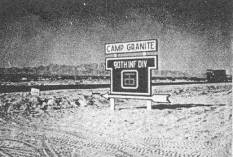
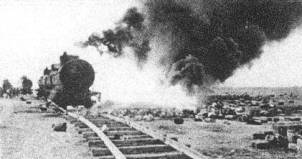
Figure 2-1 Figure 2-2
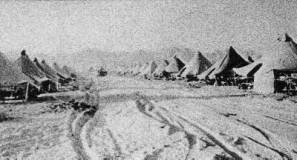
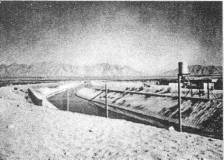
Figure 2-3 Figure 2-4
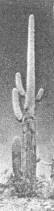
Figure 2-5