Normandy
The Normandy landings on 6 June 1944 were the biggest
amphibious operation ever. Considering the thousands of vessels involved, it is
not really surprising that in the weeks and months following the landing over
100 ships were lost from a mixture of enemy action, collisions and bad weather.
Leopoldville
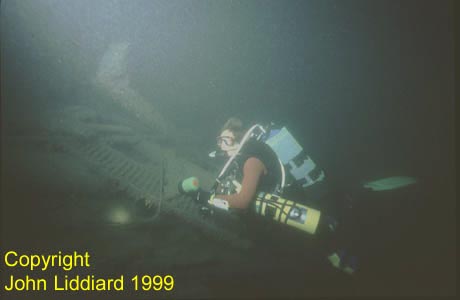 The Leopoldville was an 11,500-ton passenger liner converted for use as a
troopship. It had already made 24 crossings to Normandy transporting over 50,000
troops when it was torpedoed on the afternoon of Christmas Eve 1944, just 5
miles out from Cherbourg.
The Leopoldville was an 11,500-ton passenger liner converted for use as a
troopship. It had already made 24 crossings to Normandy transporting over 50,000
troops when it was torpedoed on the afternoon of Christmas Eve 1944, just 5
miles out from Cherbourg.
With the seabed at 58 metres, our skipper took care to hook the
shot on to the top of the wreck at just over 40 metres. My first real impression
was that 11,500 tons of passenger liner is big. I worked my way stern-wards,
through cabins in the superstructure and back to an area of debris from the
engine room. Even with 25 minutes bottom time and a fair bit of decompression I
could hardly touch on the complexity of this wreck.
LST Carbonelle
The really different Normandy wrecks are the landing ships.
These come in a variety of shapes and sizes from small infantry craft to massive
tank carrying LSTs carrying up to 20 tanks directly onto the beach.
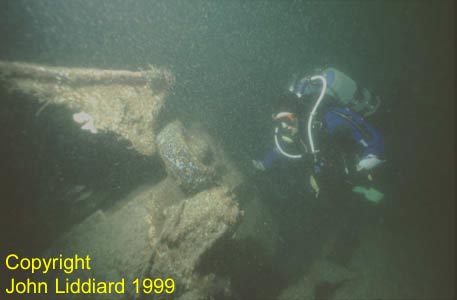 The
Carbonelle had already delivered a number of loads to the beaches when on 19
June 1944 it struck a mine off Omaha beach and sank in 29 metres, still carrying
a full load of tanks. The bow section is sort of intact with the ramp easily
recognisable and some large box sections with ribs to swim through.
The
Carbonelle had already delivered a number of loads to the beaches when on 19
June 1944 it struck a mine off Omaha beach and sank in 29 metres, still carrying
a full load of tanks. The bow section is sort of intact with the ramp easily
recognisable and some large box sections with ribs to swim through.
Further back the wreck has collapsed completely, with the main
recognisable items being Sherman tanks. The stern is reasonably intact but
upside down. The boxy interior is easy to swim through past diesel engines and
other machinery.
Susan B Anthony
The Susan B Anthony was originally built as
a combined cargo/passenger liner, the SS Santa Clara, then acquired by the US
Navy, converted to a troop carrier and renamed Susan B Anthony after a women's
rights activist.
As a troop ship, the Susan B Anthony was
fitted with gun platforms front and rear, strengthened davits for carrying
landing craft, and many large windows and portholes replaced with grey
featureless steel.
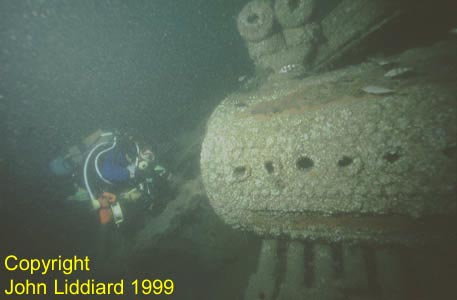 On
7 June, one day after the landings, The Susan B Anthony ran into a mine that
pierced the bottom of the number 4 hold. The ship now lies collapsed to port in
29 metres, but with the deck and remains of the superstructure mostly upright
and standing 10 metres clear of the seabed in places. Interior bulkheads have
decayed to leave just the more substantial ribs, providing cavernous areas to
swim through beneath the superstructure.
On
7 June, one day after the landings, The Susan B Anthony ran into a mine that
pierced the bottom of the number 4 hold. The ship now lies collapsed to port in
29 metres, but with the deck and remains of the superstructure mostly upright
and standing 10 metres clear of the seabed in places. Interior bulkheads have
decayed to leave just the more substantial ribs, providing cavernous areas to
swim through beneath the superstructure.
With the keel damaged by the mine explosion
the stern has pretty much split from the rest of the wreck. At the other end of
the ship the bows have fallen to port, with the gun platforms and guns still in
place, though the anchor winch has broken loose and now rests amidst a pile of
chain beneath one of the gun platforms.
Meredith III
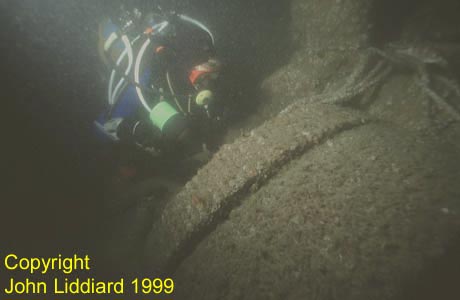 If
you are in to “eye-spy unusual methods of sinking”, the American destroyer
Meredith III had a particularly unusual end. Another early casualty of the
landings, on 7 June it was hit by a radio controlled glide bomb.
If
you are in to “eye-spy unusual methods of sinking”, the American destroyer
Meredith III had a particularly unusual end. Another early casualty of the
landings, on 7 June it was hit by a radio controlled glide bomb.
The wreckage is now well broken up. Amongst
the debris are aluminium canisters with shells inside, originally cylindrical
but now crimped square by the water pressure. Debris from the main gun turrets
with twin 5-inch guns and the enormous cogs of the turret drive mechanisms.
Behind the guns lie the boxy remains of the armoured superstructure.
HMS Seasame
HMS Seasame was an armed tug, sunk by
torpedo attack from German E-boats on 11 June 1944. Tugs are often quite well
preserved because of the strengthened structure needed to take the strain of
over-sized engines and tow-cables. Although the wheelhouse and funnel were gone,
the hull of the Seasame was completely intact.
On deck, the main points of interest were
the massively reinforced Samson posts (where the towing cables are attached)
situated just in front of a 5-cylinder steam engine.
This page and its photos are
copyrighted by and presented here as a courtesy of John Liddiard. Additional
information on wrecks he has dived on can be found at his homepage:
http://www.liddiard.demon.co.uk